Episode Library
Business Management sales management sales enablement leadership agentic AI selling fundamentals authenticity analytics improv Account Management Customer Success Sales Leadership lead generation pipeline management communication value selling language of value business transformation customer centric selling digital transformation ai-native sales effectiveness sales psychology discovery call skills sales presence building trust with buyers why deals stall consultative selling buyer resistance facts don't close deals sales leadership cross-cultural selling enterprise sales customer experience
107
Sept. 8, 2026
Change Management, Selling, Enablement — Who Are We Really Serving?
Tim Ohai thinks change management is a scam. He's got receipts — he used to be the guy they put on stage to sell it.
His argument is simple and it stings: change management is written from the organization's point of view, never the individual's. So I stopped him and asked him to swap in two different words. Sales enablement. He didn't hesitate. Same thing. We're just going to shove it onto people and hope they like it.
That's the conversation. Three disciplines, one mistake — we keep building...
His argument is simple and it stings: change management is written from the organization's point of view, never the individual's. So I stopped him and asked him to swap in two different words. Sales enablement. He didn't hesitate. Same thing. We're just going to shove it onto people and hope they like it.
That's the conversation. Three disciplines, one mistake — we keep building...

109
Sept. 6, 2026
The Second Meeting, Chapter One: What Max Taught Me About Presence
A deal stalls. The buyer goes quiet. And the industry has one answer: more. More sequences, more touches, more tooling. Then somebody says the rep needs to want it more.
The rep is almost never the problem.
In this episode, Lee reads Chapter One of The Second Meeting, the first book in the Acelera Sales Fables. Before the reading, he tells the origin story. Alex Mercer started as Stacy, a brief appearance in a nonfiction manuscript. Following her career from bank teller to VP of Sales selling ...
The rep is almost never the problem.
In this episode, Lee reads Chapter One of The Second Meeting, the first book in the Acelera Sales Fables. Before the reading, he tells the origin story. Alex Mercer started as Stacy, a brief appearance in a nonfiction manuscript. Following her career from bank teller to VP of Sales selling ...
103
June 2, 2026
You've Already Earned It. It's Just Not in the Bank.
Most companies believe revenue growth solves everything. Doug C. Brown has spent 33 years proving that the hidden profit in your business is usually a bigger opportunity than the next deal.
Doug is CEO of CEO Sales Strategies, and his premise is uncomfortable: the money you're chasing is already inside the company. You paid to acquire it. It's sitting in underpricing, in proposals nobody followed up on, in a fulfillment process that takes eight weeks when it should take one. It just never made it to the bank.
He walks host Lee Levitt through the diagnostic he uses to find it — 21 EBITDA drivers, each with five or six sub-points, applied in a fifteen-minute conversation. Then the results. A $2.4 million HVAC company that grew to $4.96 million while EBITDA moved from 13% to 28%, adding roughly a million in operating cash and $7 million in enterprise valuation. A $772,000 plumbing shop sitting on $226,000 in unclaimed EBITDA, found in two hours, with $40,000 of it recovered inside thre…
Doug is CEO of CEO Sales Strategies, and his premise is uncomfortable: the money you're chasing is already inside the company. You paid to acquire it. It's sitting in underpricing, in proposals nobody followed up on, in a fulfillment process that takes eight weeks when it should take one. It just never made it to the bank.
He walks host Lee Levitt through the diagnostic he uses to find it — 21 EBITDA drivers, each with five or six sub-points, applied in a fifteen-minute conversation. Then the results. A $2.4 million HVAC company that grew to $4.96 million while EBITDA moved from 13% to 28%, adding roughly a million in operating cash and $7 million in enterprise valuation. A $772,000 plumbing shop sitting on $226,000 in unclaimed EBITDA, found in two hours, with $40,000 of it recovered inside thre…
102
May 19, 2026
Customer-Centric Is a Decision, Not a Slogan — with Michael Skriver
A new CEO once told three thousand employees they had no clue how to sell — they were a bunch of traders. Michael Skriver was in that room, and his verdict years later is that the guy was right.
But the line that stuck was what came next: you say you're customer-centric and you actually care about it, and I want to see that in your decisions, else it's just a slogan.
That's the test this episode runs. Michael Skriver started in finance and IT before moving into sales, and he's spent his career leading complex B2B organizations across Europe and Asia. He and Lee Levitt work through what customer centricity looks like when it's an operating decision rather than a value on a wall — letting the technical seller run discovery because everyone knows the person in the tie is dangerous, especially if the title is long. Executive sponsors who put their own credibility at stake instead of approving account plans from a desk. KPIs that measure when a shipment left your factory instead of wheth…
But the line that stuck was what came next: you say you're customer-centric and you actually care about it, and I want to see that in your decisions, else it's just a slogan.
That's the test this episode runs. Michael Skriver started in finance and IT before moving into sales, and he's spent his career leading complex B2B organizations across Europe and Asia. He and Lee Levitt work through what customer centricity looks like when it's an operating decision rather than a value on a wall — letting the technical seller run discovery because everyone knows the person in the tie is dangerous, especially if the title is long. Executive sponsors who put their own credibility at stake instead of approving account plans from a desk. KPIs that measure when a shipment left your factory instead of wheth…
Guest: Michael Skriver
101
May 6, 2026
Why Buyer Confidence Is at an All-Time Low — and What to Do About It
Your car goes where your eyes go." That's a high-performance driving lesson — and it's the perfect metaphor for what's gone wrong in B2B sales. We've been staring at the wrong thing.
I'm Lee Levitt — sales coach, podcast host, and author of The Second Meeting and Together We Win, both due out later this year. Today I'm sitting down with Tom Pisello, known across the industry as The ROI Guy. Tom's been a value-selling pioneer for over 30 years — from his days as the Godfather of TCO at Gartner to founding GeniusDrive.
Buyer confidence is at an all-time low. More information, bigger committees, better tools — and yet two-thirds of buyers regret their decisions shortly after the ink dries. Why?
Here's what to listen for: Aristotle's three buy buttons — pathos, logos, and ethos — and why trust now accounts for 50% of the decision. The shift from fear of missing out to fear of messing up. And why more information doesn't create more confidence.
If you've ever had your best ROI …
I'm Lee Levitt — sales coach, podcast host, and author of The Second Meeting and Together We Win, both due out later this year. Today I'm sitting down with Tom Pisello, known across the industry as The ROI Guy. Tom's been a value-selling pioneer for over 30 years — from his days as the Godfather of TCO at Gartner to founding GeniusDrive.
Buyer confidence is at an all-time low. More information, bigger committees, better tools — and yet two-thirds of buyers regret their decisions shortly after the ink dries. Why?
Here's what to listen for: Aristotle's three buy buttons — pathos, logos, and ethos — and why trust now accounts for 50% of the decision. The shift from fear of missing out to fear of messing up. And why more information doesn't create more confidence.
If you've ever had your best ROI …
Guest: Thomas Pisello
100
May 5, 2026
If Sales Is a Game, You Make the Rules — Chris Carter on AI, Preparation, and Winning on Your Terms
Chris Carter — technologist, keynote speaker, and SAP ecosystem veteran — joins Lee to unpack what it actually means to use AI well in enterprise selling. From using Gemini to simulate discovery conversations to the Peloton analogy that woke up a room of Oracle salespeople, this episode is about preparation, strategy, and making your own rules. If you're firing off AI-generated emails and wondering why nobody's responding, this one's for you.
99
April 30, 2026
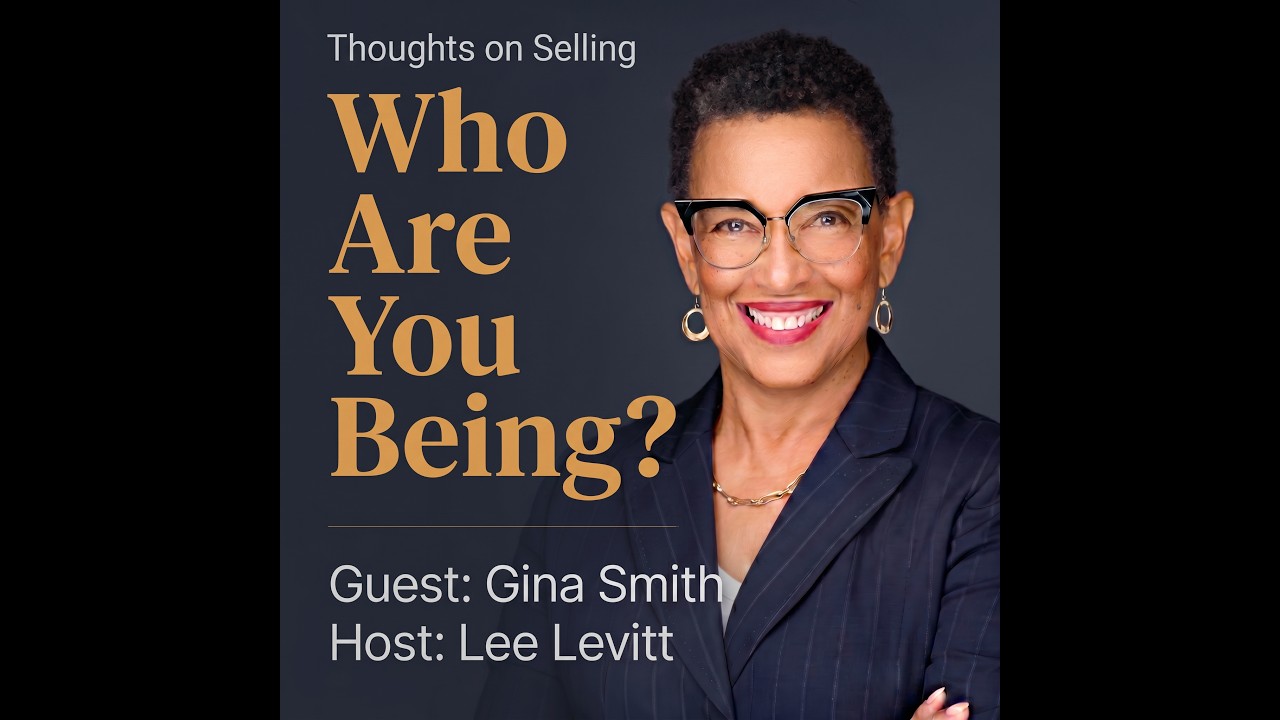
Who Are You Being? — Gina Smith on Trust, Listening, and the Real Job of a Salesperson
Gina Smith didn't plan to spend 27 years in sales. She planned to stay in HR — until a sales manager walked into her office and asked if she knew anyone who could fill an open role. She interviewed. She won. And what followed was a career that taught her everything she needed to know about trust, listening, and what actually moves buyers in complex environments.
In this conversation, Gina and Lee explore the gap between what people believe salespeople need to be and what the best salespeople actually are. They cover the shift in hospital buying dynamics, why honesty is a competitive advantage, and why no amount of process documentation will close the gap when the real variable is who you show up as. A sharp, grounded conversation for anyone selling in environments where the relationship has to come before the recommendation.
In this conversation, Gina and Lee explore the gap between what people believe salespeople need to be and what the best salespeople actually are. They cover the shift in hospital buying dynamics, why honesty is a competitive advantage, and why no amount of process documentation will close the gap when the real variable is who you show up as. A sharp, grounded conversation for anyone selling in environments where the relationship has to come before the recommendation.
Guest: Gina R. Smith
98
April 20, 2026
Don't Bring Facts to a Feelings Fight: The Science of Persuasion and Trust in Sales
Danny Bobrow—communication coach, mountaineer, and creator of the Persuasion Blueprint—joins me for a conversation about the science and art of persuasion. Danny spent 36 years in marketing before discovering that getting the phone to ring was only half the problem—how calls were handled determined success or failure.
That led him to develop a framework built on three C's: Caring, Connection, and Collaboration. We dig into the brain science of resistance (amygdala, limbic system, prefrontal cortex), Mehrabian's research showing words account for only 7% of effective communication, and the counterintuitive lesson from a health club saleswoman who outsold everyone by letting prospects stay in control.
Danny's mountaineering background surfaces throughout—the psychological fatigue barrier, "patiently persistent and respectfully resilient," and the Sherpa model for coaching. If you've ever wondered why your best facts-based pitch falls flat, this conversation will show you what's ac…
That led him to develop a framework built on three C's: Caring, Connection, and Collaboration. We dig into the brain science of resistance (amygdala, limbic system, prefrontal cortex), Mehrabian's research showing words account for only 7% of effective communication, and the counterintuitive lesson from a health club saleswoman who outsold everyone by letting prospects stay in control.
Danny's mountaineering background surfaces throughout—the psychological fatigue barrier, "patiently persistent and respectfully resilient," and the Sherpa model for coaching. If you've ever wondered why your best facts-based pitch falls flat, this conversation will show you what's ac…
96
April 7, 2026
Get Your Prospects to Notice You: Customer Centric Sales Engagement Practices that Really Work
Kris Rudeegraap—co-founder and co-CEO of Sendoso—joins me to talk about what happens when email stops working and you have to find another edge. Kris was a top seller who got 90% response rates in the early 2010s using mail merge. Then email sequencing tools flooded the market and response rates tanked. So he started sending handwritten notes, dog toys, and swag from the marketing closet—and booking more meetings than anyone else.
That curiosity—hearing a dog bark on a call and sending a dog toy—became the foundation of Sendoso, now the largest direct mail and gifting platform in the world. We cover the psychology of reciprocity, why the open rate of a FedEx box is 100%, and why dimensional mail is the channel that never stopped delivering.
The Kansas City ribs story is one you won't forget: a prospect broke a rib skiing, so the Sendoso team sent a rack of BBQ ribs to his office. He shared the story with his whole company, and they got the deal.
Kris's motto—"people buy from pe…
That curiosity—hearing a dog bark on a call and sending a dog toy—became the foundation of Sendoso, now the largest direct mail and gifting platform in the world. We cover the psychology of reciprocity, why the open rate of a FedEx box is 100%, and why dimensional mail is the channel that never stopped delivering.
The Kansas City ribs story is one you won't forget: a prospect broke a rib skiing, so the Sendoso team sent a rack of BBQ ribs to his office. He shared the story with his whole company, and they got the deal.
Kris's motto—"people buy from pe…
Guest: Kris Rudeegraap
95
April 1, 2026
Build How Customers Want to Buy
Juan García—co-founder of Tuio, an AI-native insurer based in Spain—joins me to talk about what happens when you rethink an industry from first principles. Juan started in engineering at Cisco, moved through strategy consulting, and then built Orange Insurance—where he saw just how broken the insurance industry really was.
The 25-55 customer segment is digitally native. They buy groceries online, manage finances on their phones, and don't want to call anyone. But legacy insurers weren't built for them—and worse, this segment was unprofitable because they're too informed. They use price comparison sites. They read Trustpilot. They know what they're buying.
So Juan and his co-founders built Tuio: a self-service, data-driven platform where customers actually buy insurance themselves. They went against the industry mantra—"insurance is not bought, it's sold"—and proved it could work.
The AI applications are fascinating. They can see which device you're browsing from and adjust risk pri…
The 25-55 customer segment is digitally native. They buy groceries online, manage finances on their phones, and don't want to call anyone. But legacy insurers weren't built for them—and worse, this segment was unprofitable because they're too informed. They use price comparison sites. They read Trustpilot. They know what they're buying.
So Juan and his co-founders built Tuio: a self-service, data-driven platform where customers actually buy insurance themselves. They went against the industry mantra—"insurance is not bought, it's sold"—and proved it could work.
The AI applications are fascinating. They can see which device you're browsing from and adjust risk pri…
Guest: Juan Garcia fernandez