Build How Customers Want to Buy

Juan García—co-founder of Tuio, an AI-native insurer based in Spain—joins me to talk about what happens when you rethink an industry from first principles. Juan started in engineering at Cisco, moved through strategy consulting, and then built Orange Insurance—where he saw just how broken the insurance industry really was.
The 25-55 customer segment is digitally native. They buy groceries online, manage finances on their phones, and don't want to call anyone. But legacy insurers weren't built for them—and worse, this segment was unprofitable because they're too informed. They use price comparison sites. They read Trustpilot. They know what they're buying.
So Juan and his co-founders built Tuio: a self-service, data-driven platform where customers actually buy insurance themselves. They went against the industry mantra—"insurance is not bought, it's sold"—and proved it could work.
The AI applications are fascinating. They can see which device you're browsing from and adjust risk pricing accordingly. They can detect when someone reads one specific coverage very carefully during checkout—and flag that customer for closer review if they file a related claim in the first week. They even caught their first AI-generated fraud photo recently (it was terrible).
On the marketing side, they've built an AI agent that optimizes campaigns in near real-time—what used to take days of analysis now happens in minutes. The feedback loop between marketing and sales is bidirectional and continuous.
Juan's final point stuck with me: "There is no more marketing or sales. There's marketing and sales. It's just the same thing."


Juan García is the co-founder of Tuio, an AI-native insurance company based in Spain. Before starting Tuio, Juan was an engineer at Cisco, a strategy consultant focused on marketing and sales, and the builder of Orange Insurance in Spain's new ventures division. That's where he saw just how broken insurance was—and decided to do something about it.
This conversation covers revolutionary thinking, the psychology of digital-native customers, and how AI is changing not just marketing and sales, but the entire operating model of a business.
What we cover:
- Why insurance is "even more broken" than telecommunications—and what that creates
- The 25-55 customer segment: digitally native, financially literate, and unprofitable for legacy insurers
- "Insurance is not bought, it's sold"—and why Tuio went against 100 years of common knowledge
- Reproductive vs. productive thinking: Kaizen improvement vs. revolutionary change
- How iPhone users file more expensive claims—and why that data matters
- Detecting fraud before claims are filed: browsing behavior, metadata, and Google Images
- The first AI-generated fraud photo (it was really bad)
- Marketing campaigns that run for minutes, not months: AI agents and always-on optimization
- "There is no more marketing or sales—there's marketing and sales"
- Why AI will be powered by startups and founder-led companies, not large public companies
- The Tuio name story: from Coconut to "we protect what's yours"
- Why an intern named the company—and why she's still there five years later
Key insight: "For us, there is no more marketing or sales. There's marketing and sales. It's just the same thing. You want to sell the product to a customer. Everything else is just noise and tools."
Connect with Juan:
- Website: tuio.com
Help us grow the podcast reach!
Please comment on and share the podcast. Tell two coworkers about what you loved about this episode!
And...leave a personal message for us...click on the microphone icon on the right.
Thanks!
Thoughts on Selling™ is a trademark of The Acelera Group, LLC. All rights reserved. Federal trademark registration pending.
Lee Levitt: Today it is my pleasure to have Juan García join. Juan and I have been chatting about bicycles and sales and AI and all sorts of good stuff. I'll start with the first question that I've already prepped Juan for. Juan, who is Juan García?
Juan García: That's a great question. You could probably ask three different people and they'll give you three different answers. I am an entrepreneur. I haven't always been an entrepreneur. I'm an engineer by trade—I studied telecommunications. I started working in technology at Cisco Systems.
Then I moved to do strategy consulting, mostly working in marketing and sales for technology companies and third-party companies. Then I started building the new ventures division at Orange Spain. That's how I fell in love with insurance—or rather, I saw a problem. We built Orange Insurance and I just realized how broken insurance was.
Now I'm building Tuio with two other co-founders. Tuio is an AI-native insurer. We started thinking there was something we could do with technology to make insurance more transparent, more friendly, and cheaper as well—which probably all your audience can relate to.
Lee Levitt: I love that. As part of your introduction, you talk about insurance as an industry that's ripe for change. Most of the players in the insurance industry are 100, 150 years old. They're very resistant to change. I've called on many of them in the Northeast—risk averse, late adopters, they know what they do for customers. It's not flashy. Nobody wants insurance. Nobody wants to pay for something they hope never pays off.
Yet we all do it because it's a risk-benefit analysis. And you come along with an idea that there might be an opportunity to do things differently.
Juan García: Right. We all buy insurance because it's a sensible option, not because it's a sexy option. I just realized that insurance, at least the digital side, was broken. And as broken as telecommunications are—which we all know they kind of are—insurance is even more broken.
It was an industry that didn't have end-to-end data movement. Most of the time, their websites couldn't even give a price. Connecting to the core systems was cumbersome because they didn't have APIs. For someone coming from the tech side of the world, some of the stuff we stumbled on was incredible. This is just broken. There must be a way to do things better.
It's old-fashioned for a reason—it's very risk averse. You only have a relationship with a customer when you sell and when you have a claim. There's no recurrent conversation with a customer, so there's no benefit to having a better experience.
Lee Levitt: I want to pause there for one second. We're going down a conversation path about insurance, but I want to point out for the listener that this is not an insurance-specific story. This is a general purpose story of just because the way things are doesn't mean you need to do things that way.
There's a book I recently read called Thinking Better. One of the primary posits is there are two ways of thinking. Reproductive thinking—the Kaizen method—if we're doing something today, let's do it 1% better tomorrow. And then productive or revolutionary thinking—just because the industry has done it this way for a hundred years doesn't mean you should do it that way today.
You've stepped back and said, here is the market. Here are the changing demographics and psychographics of people in this market. Someone who is 25 years old doesn't use a telephone for the purposes of talking. They use a telephone for almost everything, but they don't talk on it.
Juan García: It is. I have an iPhone and I just don't use it for calling. I mostly use Google Meet or Teams for video chat. The experience of the telephone is just getting aged. Some people even find it intrusive—it interrupts what you're doing.
So we saw this customer segment—25 to 55, roughly—that has different behaviors. They consume content through Netflix. They buy stuff on Amazon. They even buy groceries online. These customers were puzzled by the actual experience of buying insurance. "I have to go to a physical store? I have to call someone? There's no online option?"
We found this customer segment wasn't only underserved—it was also problematic for insurers. This segment is online a lot. We browse a lot. We use price comparison websites. We have more financial literacy. We know what we're buying without needing to talk to anybody.
That puts pressure on top line—you can't upcharge. And this segment uses the product more. They have more claims and more expensive claims because they know what they're buying. So you have pressure on top line and bottom line. This segment is basically not profitable for insurers.
So for us, we saw this double-sided problem. In Spain there's this mantra that's very pervasive in the industry: "Insurance is not bought, it's sold." We said, we're going to go against the grain, against a hundred years of common knowledge, and try to have the customers do our work for us.
Lee Levitt: Right.
Juan García: Five years later, we can prove that we could make customers buy insurance themselves. And this is something that was only natural. Every other industry has it. Banking has it. Telecommunications has it. Insurance was just a little behind on times.
Lee Levitt: If I want to buy a new Volvo, I can go onto Volvo.com and configure a complete vehicle. Couldn't do that 10 years ago. You had to go to a dealer. People's expectations of how to buy everything have been consumerized based on our Amazon experience.
You didn't recreate a legacy business in the cloud. You started from scratch. How do we manage risk? How do we evaluate behaviors so we optimize to provide a good and profitable service—and also don't get taken? Because insurance is a place where sometimes people cheat.
Juan García: Correct. So what we did at the beginning is we took all the behavioral data from the onboarding process and we started looking at what we called the "customer DNA"—all the different digital signals. Then we plugged them into the pricing engine.
One of the things that we learned is that if you were browsing or purchasing our policy from an iPhone or a MacBook, then you more often than not would have more expensive claims. And we could prove it. We were completely integrated along the customer lifecycle.
Lee Levitt: I love that you're using device access to give you a window into the psychographics of the customer. From now on, every time I go shop for anything on the internet, I'm going to pull out my Windows 5 machine.
Juan García: Ha! But it's not only pricing. Some of the behaviors that people exhibited in the onboarding process would actually predict behaviors they would have along the lifecycle of their policies.
One of the things we had an aha moment with: when a customer is buying the policy, navigating normally, maybe a little rushed—but then they get to the quote page, scroll up, scroll down, don't read anything. But then they read one specific coverage very carefully. Click to see more. Read everything. Then purchase.
We saw that more often than not, they would have a claim related to that coverage in the very first week of their policy.
Lee Levitt: Wow.
Juan García: You shouldn't use this for pricing because you don't know they're going to have a claim. But we flag it. When this customer files a claim in the first or second week, we look at it more closely.
We have this whole digital claims filing process where you take a video from your phone or send pictures. One of the things we find—it's not large-degree fraud, it's opportunistic—is that the video or pictures were taken before they purchased the policy. They knew that claim wasn't covered.
Some of them erase the file name, but you still see the metadata. And some—this is the funny part—you see that the picture is from Google Images. But it's not from the 10th page. It's the first result from the first page.
Lee Levitt: I think good criminals are so lazy.
Juan García: We had this funny story two weeks ago. We had the first picture done by AI—at least the first one we realized was AI. We were laughing about it in our internal chat. They could have used a better tool. It was really bad. You could see the glass was flying a little bit—not really on top of the table. The different pieces were different sizes.
Lee Levitt: That's crazy. You're using the tools of the time to create a better experience for the business and your customers. When someone cheats, that drives pricing up for everyone. When you avoid paying a falsified claim, that benefits all your legitimate customers.
Juan García: It also enables us to divert how we treat claims. If there's nothing flagged and it's clear-cut, we do it very fast. But if we have to investigate, we take more time. Filing a claim is a vulnerable moment—something happened with your car, with your house. It's a very central part of your life. So we want to make it very fast for good customers. If we verify it's a perfect customer—been with us three or four years, never had a claim, the video looks perfect, no issues with the metadata—we can go very fast. That's what we're built for. We're built for people who are not gaming the system.
Lee Levitt: A lot of what we're describing from a marketing standpoint would fall under intent signaling—the activities that a customer takes interacting with your systems without being specifically in a selling conversation. I sold predictive analytics packages 10 years ago to some very large companies. This is not new. We've been doing predictive analytics and intent signaling and sentiment analysis for a long time. What I think you're pointing to that's changed is the ability to hoover up all that data in near real time and act on it.
Juan García: For sure. We have this agent, and for us selling is basically having as many customers go through our onboarding, get to the quote page, and decide they want this. We do a lot of work in digital marketing—that's our bread and butter. As opposed to other companies, that's a core competency for us. We don't use agencies. We do it all ourselves.
One of the big changes from 2021 to now is the generative AI revolution. As Aziz, one of my co-founders, used to say: the difference between AI and machine learning is that machine learning runs on Python and AI runs on PowerPoint. AI was there, it's just a different type of technology. We could do the customer DNA from the very beginning.
But now you can augment your teams to do things that would have been too complex or time-consuming before. What would take a team days of analysis now happens in minutes.
In Google, you have your campaigns. Before, because you couldn't be as granular, you'd have a reduced number of campaigns with broad matching—one or two keywords and everything that has those keywords matches and spends money. For a human to manage 100 or 150 campaigns with exact matching is just not manageable.
Now we built an agent using the MCP protocol to track all the data from ad platforms. We use it on Meta as well. We reduced the time to insight by 90%—what we did in days now happens in minutes. It goes through all the campaigns and keywords, identifies waste, suggests actions to reduce that waste. Some of them we execute automatically. We have confidence thresholds. If the machine is very confident, you can automate it.
This has enabled us to turn marketing into always-on optimization in a loop. We've gone from a smallish set of campaigns with broad matching to a very extensive tree with almost only exact matching, because the machine can go through all of that and tell us which campaigns are performing well and which are not.
Lee Levitt: This is crazy, Juan. When I first was involved in marketing, campaigns would run six months. Now what you're describing is a specific instance of a campaign might run five minutes.
Juan García: Well, we do week-to-week analysis—that's the amount of time we found works best for selling insurance. We started only looking at keywords. Then we started looking at ad copy. Then we started looking at different combinations of ad copy, website, and keyword. Now we have a machine that enables all these combinations that would be impossible for a person to do.
Lee Levitt: In the past, sales and marketing haven't worked that closely together in much of the world. Marketing does the one-to-many and they throw some leads over the fence and sales says, this is crap, we're going to do our own. It's never been a happy relationship. What you've described is a bidirectional feedback loop—we're converting customers that come down this pipe faster, so let's get more of them.
Juan García: That seems obvious now when we're talking about it, but we didn't start that way. We started looking at how many people went from the ad to the website. Then we realized the signal we wanted was how many people actually see our price. Then we thought, why don't we go further and look at people who are actually buying?
It's true that if you're looking at people going from ad to website, you can run a campaign for five minutes. But as you go further in the funnel, you have to run longer. We ended up on week-to-week analysis—that's the amount of time we found works best for selling insurance.
We started only looking at keywords. Then we started looking at ad copy. Then different combinations of ad copy, website, and keyword. Now we have this machine that enables all these combinations that would be impossible for a person to do.
This is an unfinished product. We continuously improve both our marketing system and the capabilities of the agent. It's basically the Toyota process all over again—an ongoing loop of improvement. Marketing assets are not just the ads now. Everything is marketing. Or everything is sales. You could look at it from either angle. For us, it's the same thing.
Lee Levitt: You've reinvented the process of buying insurance. You've reinvented the process of selling insurance. And you've reinvented the process of managing an insurance company.
Juan García: We're still in process of that. One of the things about AI is that I believe it's a technology that's going to be powered by startups or smaller companies or founder-led companies.
Public companies are so large. They have entrenched processes. They're very deterministic. For a project to go live, they have to have a very clear image of success and a very clear goal. With AI, it's different because the technology is so new and the capabilities have advanced so fast.
We started looking at keywords. Then keywords and copy. Then keywords and copy and landing pages. Then the whole process. And who knows where we're going next.
Lee Levitt: What does Tuio mean?
Juan García: So "tuyo" is a Spanish word—spelled t-u-y-o—meaning "yours." When we started, we realized "tuio"—spelled t-u-i-o—is a wordplay on "tuyo." The .com was available and not too expensive. And .coms tend to be trustworthy, which was desirable for an insurer targeting online customers.
Our claim is "we protect what's yours"—"protegemos lo que es tuyo." Now we can use our name, which is tuio, without the y.
Funny story: we named ourselves Coconut at the very beginning. Then we were about to file the brand and couldn't because there was already a company called that in the UK. We were about to launch to market. We had everything done for Coconut and had to redo everything.
We started this crazy democratic process to select a new name. The funny thing is the only person who actually got clarity for the name was one of the interns. She's still with the company five years later—her first job.
Lee Levitt: Give her a callout by her first name.
Juan García: Irene. She had the clarity to pick a better name than those we engineers were trying to pick. I still have the picture of the whiteboard where we started describing the different names. Some of them were awful. We're so lucky she was there.
Lee Levitt: You had come from Orange and you were looking for another round edible thing and went to Coconut. But coconuts are hard on the outside, spiky, you can't get in. And when they fall on your head, it hurts. So much for branding.
Juan García: And I hate coconuts! I hate the coconut flavor. Whenever there's chocolate with coconut, I just don't want that.
Lee Levitt: Well, Irene, well done. Juan, we've covered a lot. Thinking differently, not taking what's given as given. In today's business environment, customers need us to think differently. Customers need us to serve them differently—to their benefit and to ours.
Drucker said the purpose of a business is to create a customer. Not to create great widgets. Not to build tall buildings. To create customers. You've taken a customer-first perspective on building the business and how customers are served.
This is a general-purpose learning for anyone running a sales organization or anyone who's a chief revenue officer.
Where can people find you?
Juan García: They can find us at tuio.com—t-u-i-o.com. They can find us on our socials as well.
If I have to give a final remark: B2B is obviously different, but in B2C, to me, there is no more marketing or sales. There's marketing and sales. It's the same thing. You just want to sell the product to a customer. Everything else is just noise and tools.
Lee Levitt: I love that. Juan, thank you for your time. This has been absolutely fascinating.
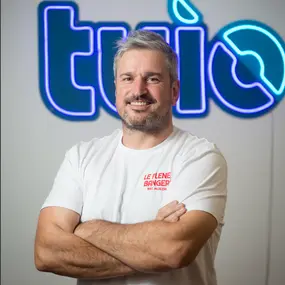
Co-founder and co-CEO
Juan García is one of the Co-founders of Tuio, a next-generation insurer built from the ground up with artificial intelligence at its core. Tuio’s ecosystem of AI agents — including Leia, Watson, Lisbeth, Sonia, and George — now automate over 80% of customer interactions and 85% of simple claims, showing how AI can rebuild trust in financial services through transparency and efficiency.
Juan oversees Tuio’s brand, growth, and product strategy, blending design thinking with operational rigor to create a customer experience that feels more like modern software than traditional insurance. Before founding Tuio, he spent 20 years helping companies scale at the intersection of technology and finance — including leadership roles at Monitor Deloitte and global experience in affinity insurance distribution (e.g., Orange Seguros).
A telecommunications engineer and La Caixa Fellow, Juan holds an MBA from London Business School and CEIBS.
Juan García is co-founder and Co-CEO of Tuio, Spain’s 100% digital, AI-native insurer creating next-generation insurance solutions for a customer-centric, tech-driven world. Under his leadership, Tuio has rapidly scaled from a garage startup into a multi-million euro fintech-insurtech raising major backing and redefining what “insurance” means for the digital generation.
Juan García brings a unique blend of telecommunications engineering, strategic consulting and startup leadership to his role at Tuio. With a passion for transforming legacy industries through technology, he embarked on the mission of reinventing in… Read More

