You Can't Automate Likability: Why AI Will Never Replace the Human Connection in Sales
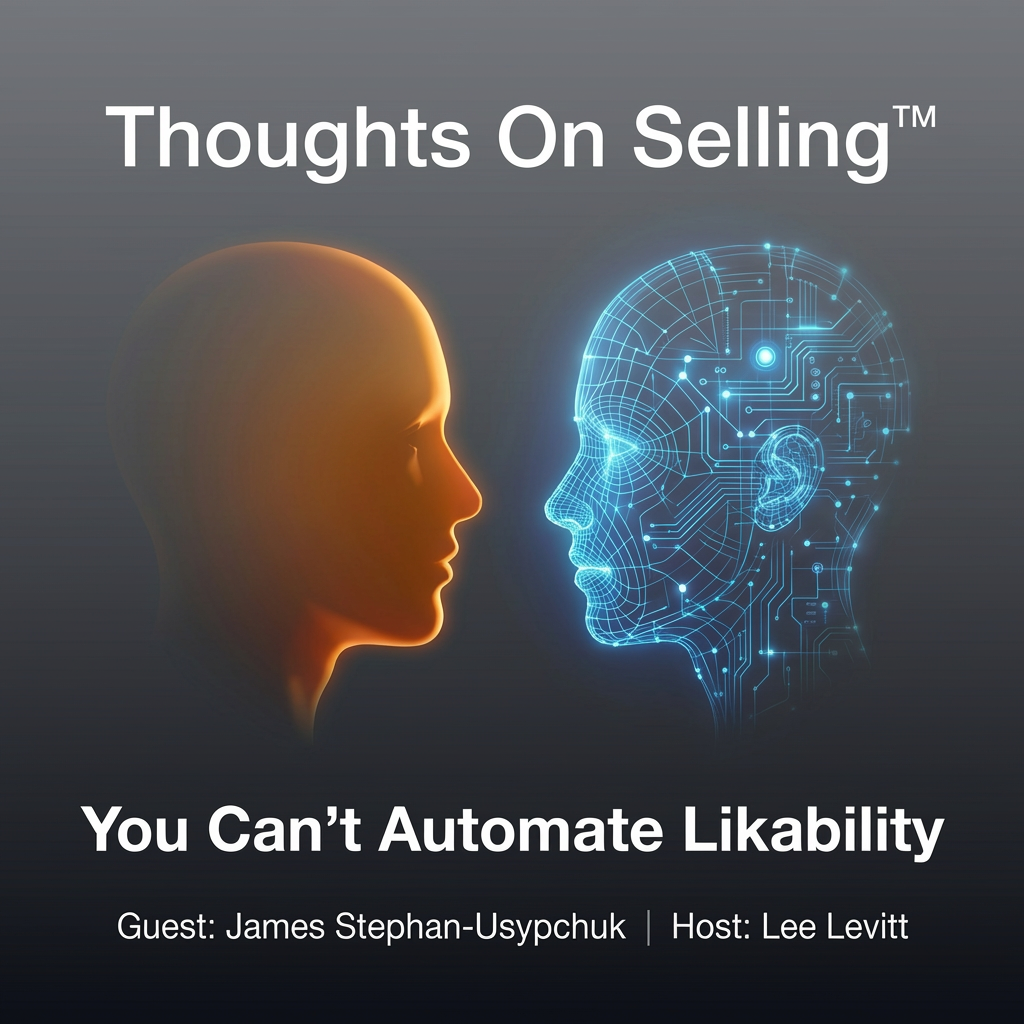
You Can't Automate Likability: Why AI Will Never Replace the Human Connection in Sales
There's a question every sales leader is grappling with right now: What should AI actually do for us?
Not what can it do—we know the list is long and getting longer. The question is what should it do, and more importantly, what should it never touch?
I sat down with James Stephan-Usypchuk on the Thoughts on Selling podcast to dig into this. James has been building predictive AI systems for 15 years—long before ChatGPT made it mainstream—and he brings a psychology degree to the conversation, which gives him a different lens than most technologists.
His answer surprised me. Not because it was contrarian, but because it was so clear.
The Magnet in the Ocean
James runs Ecliptical, a firm that uses AI and predictive algorithms to identify acquisition targets for private equity. His systems can find business owners who are likely to sell, pull firmographic data, build psych profiles, even predict the probability that a target will be interested.
But here's the thing: when it's time to actually have a conversation, they always inject a human.
"You use it like a magnet in the ocean to collect all the fish and the type of fish you want," James told me. "But you don't have it process the fish and start making sushi on the back of a boat."
That's the line. AI is the magnet. Humans make the sushi.
The 50 Million Problem
James made a point that stuck with me: "AI can do everything, but so can 50 million other people who are using AI."
When everyone has access to the same tools, the tools stop being a differentiator. What differentiates you is how you show up as a human being.
"When a human is able to step up and be like, 'Oh, this guy has got a likability factor I've never seen—I don't care what his tech does, I wanna work with him,'" James said. "Automate that."
You can't. And that's the point.
Trust Can't Be Coded
I pushed back a little. Played devil's advocate for our electronic friends. Fully autonomous driving, I pointed out, is statistically safer than letting most humans on the road.
James didn't disagree. But he drew a distinction between replacing mundane tasks and replacing high-stakes decision-making.
"When we're talking massive, life-changing decisions—tens of millions of dollars that move markets—I don't think the gravitas of that equates to the self-driving car," he said.
The person writing the check will always want to look into someone's eyes. They need confidence. They need to feel something that a report—no matter how accurate—can't provide.
And here's the kicker: if they pull the trigger on a deal that no human ever vetted, and it goes wrong? "It takes one person to be wrong for millions of dollars to go down the drain, and the trust behind the system erodes very quickly."
The Disclosure Problem
James has experimented with AI avatars, voice agents, the whole stack. But he's clear-eyed about the limitations.
"There are disclosures that need to be made when you're talking to an AI agent," he said. "And when you have to disclose it, you completely disarm its actual use."
The magic was supposed to be that the AI would replace the human condition and create something authentic. But the moment you say "by the way, this is a bot," you've undone whatever you thought you were harnessing.
He sees this constantly in cold email and cold outreach. "It's the biggest fallacy out there."
15,000 Impressions, 3 Seconds of Recall
Here's a stat James dropped that floored me: the average person sees 15,000 to 20,000 ad impressions per day. And that was from 2012—it's almost certainly higher now.
Think about that saturation. Brands on your clothes. Billboards. Podcasts. Emails. Social feeds. All competing for attention.
And out of all that noise, you need to stitch together enough micro-moments to earn three seconds of actual recall.
Now compare that to a real conversation where you have 100% of someone's attention.
"Just think of how you're supercharging that," James said. "They're gonna remember how you made them feel."
The Elevator Test
I gave James a scenario. You're an enterprise rep. You're about to visit the VP of Marketing on the third floor. You get on the elevator. Someone else steps on—and you realize it's the CEO. She hits 27.
You're not going to 3. You're going to 27. What do you say?
James's answer: don't try to recall information. Play to your strengths.
"In the 45 seconds you have, what are they gonna likely remember? Your ability to recall information? Or how charming or likable you were?"
The recall is what AI replaces. The likability is what you bring.
"That's how you build rapport. And I can tell you, I know a lot of people who exited one company and went to another—you'd be surprised how many people bring people they like just because they know they work well together or they like how they vibe."
The Art of Being Human
Near the end of our conversation, James made an observation that landed hard.
Four out of five enterprise reps fail on the first call because they're pitching rather than asking questions. They're running a script instead of reading the room.
"I've had PE firms say, 'Proposal is no problem. Finance is not the issue,'" James said. "And then you go back and forth and you realize—it was trust. They need to like working with you. That's it."
That's the simplest recipe. And it has nothing to do with ChatGPT or Claude or Crystal or any other tool.
"The final part is the art of being a human being," James said. "Listening. Being in the moment."
Dan Pink says improv and enterprise sales are the same thing. James took that seriously—he joined a local improv troupe.
"You have to be present. You don't have time to think," he told me. "Being in the moment and responding—having the muscle memory to know how to respond—is far more powerful than sitting there thinking, 'What should I say?'"
The Bottom Line
AI is a magnet. Use it to find the fish. Use it to sort the data. Use it to predict probabilities.
But when it's time to build trust, close the deal, or earn a place in someone's memory—that's on you.
Because likability can't be automated. And in a world where everyone has the same tools, how you show up as a human being is the only real differentiator left.
Listen to the full conversation with James Stephan-Usypchuk on the Thoughts on Selling podcast. Connect with James at ecliptica-ops.com or find him on LinkedIn.