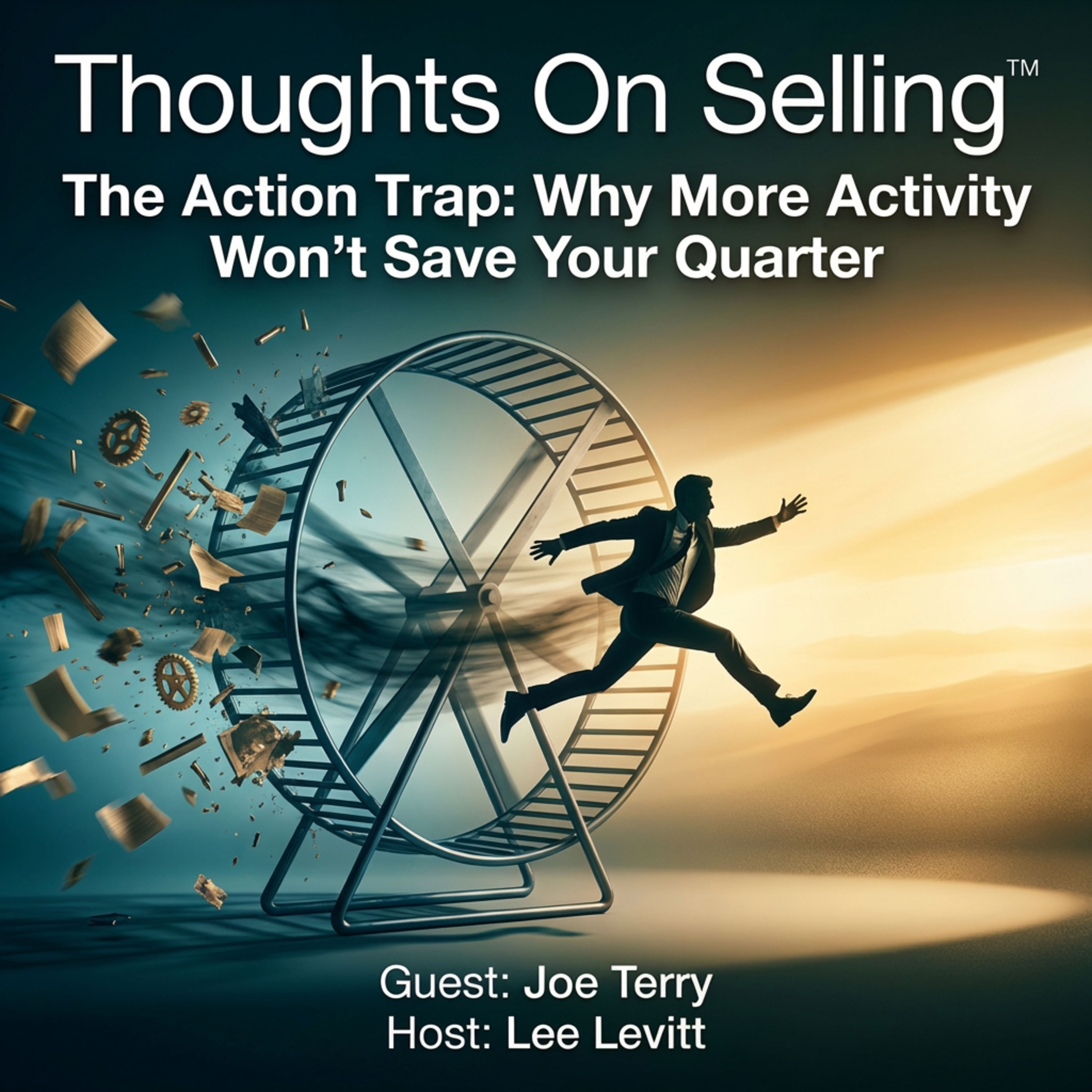
The Action Trap: Why More Activity Won't Save Your Quarter
Pattern Matching
Here's a pattern I see constantly: A sales team hits every activity metric—calls made, emails sent, meetings booked—and still misses the number. So leadership responds with... more activity metrics.
It doesn't work. And Joe Terry knows why.
I sat down with Joe on the Thoughts on Selling podcast this week. He's the former CEO of Corporate Visions, co-author of the USA Today bestseller Surrender to Lead, and someone who's spent 30 years watching organizations confuse motion with progress.
His diagnosis? We're caught in the action trap.
The Action Trap
"If you don't create different experiences and shift the belief structure and know what that is," Joe told me, "you can do all the actions you want all day long. You might get a little short burst, but you're not going to get long-term repeatable change in execution and results."
That's the trap. We run to action because action feels productive. Activity dashboards light up. Pipeline reviews have something to inspect. But activity isn't results.
Joe and his co-author Jessica Siegel call this the "results pyramid": Experiences shape beliefs. Beliefs drive actions. Actions create results.
Most sales training starts at the wrong end. We train actions—what to say, how to handle objections, when to close. But if the underlying beliefs haven't shifted, those actions don't stick. You get compliance for a week, then everyone reverts.
The Alignment Problem
Here's a stat that should terrify every CEO: Joe walks into executive team meetings and asks, "What are the top three objectives the company's trying to achieve?"
The response is always the same: "Everybody knows it."
Then he goes around the room. Twelve executives. Twelve different answers.
"You have 5,000 employees," Joe says, "and the 12 of you in this room are not aligned on what this company does. How do you expect the 12,000? You're losing the power of those people."
This isn't a communication problem. It's a clarity problem. And you can't activity-manage your way out of it.
Show Up to Give, Not to Get
The phrase that stuck with me from our conversation: "We show up to give, not to get."
If you want anything in life, Joe says, you have to give it away first. If you ever feel lack—love, money, respect, kindness—you've got to give it out.
Apply that to sales. Most reps walk into a meeting thinking about their number, their quota, their commission. The customer can feel it. And they respond accordingly—guardedly, transactionally, defensively.
But if you walk in thinking, "I'm here in service. I'm grateful for this meeting. My job is to help this person achieve their results"—that creates a different experience. And different experiences shape different beliefs.
Joe put it bluntly: "I just want some seller one day to start with, 'Hey Joe, what are your top three results you're looking to achieve as a company?' And please tell me how you're going to help me achieve that. Because if not, we're wasting our time."
That's how you earn the second meeting.
The SHIFT Framework
When Joe finds himself operating from ego—getting defensive, protecting turf, fighting reality—he uses a framework he calls SHIFT:
S – Stop fighting what is. Reality is reality. Stop arguing with it.
H – Have faith. Not religious faith necessarily—faith that this is going to work out the way it should for the right reasons.
I – Identify what's mine. This is where it gets real. What am I contributing to this problem? Who am I being?
F – Free yourself from fear. What am I afraid of? Usually it's something about ego—being wrong, losing control, not getting what I want. Name it. Release it.
T – Take action. Now—and only now—act. But act from a place of love, abundance, and gratitude. Not from fear, ego, and scarcity.
That's not soft. That's the hardest work there is.
Surrender Is Strength
The title of Joe's book is Surrender to Lead. And he knows how that sounds.
"Surrender is not weakness," he told me. "It's strength."
You can only operate from one plane at a time: ego or love. Fear or gratitude. Scarcity or abundance. You can't do both. Surrender means letting go of the ego plane so you can lead from the other one.
The leaders who connect—who build teams that execute, who create cultures that perform—they've figured this out. They're not grinding harder. They're operating from a different place entirely.
The Bottom Line
More activity won't save your quarter. More pipeline inspections won't fix your team. More dashboards won't create alignment.
What will? Clarity on the three things that matter. Belief systems that support the behaviors you need. And a mindset that shows up to give, not to get.
That's how you escape the action trap.
Listen to the full conversation with Joe Terry on the Thoughts on Selling podcast. Connect with Joe at surrendertolead.com, culturepartners.com, or find him on LinkedIn.